 how-to
7 Steps to Choose the Best Breakfast Tea Blend
Last Updated: November 14, 2026
Quick Summary
To choose a breakfast tea blend, first decide which flavor direction you want: malty, brisk, or smooth. If you take milk and sugar, pick a malty, full-bodied blend that holds its character; if you drink it black, a brisk cup gives more lift. Then check the ingredient list, since the first tea named is the dominant one.
- English Breakfast and Irish Breakfast are style names, not protected recipes, so two boxes with the same label can taste completely different.
- Irish Breakfast usually leans harder on Assam, often two parts Assam to one part Ceylon, for a stronger, thicker body.
- Ingredients are listed in descending order by weight, so the first tea named is the dominant one.
- Irish-style blends often peak at 4 to 5 minutes, while English-style blends can taste muddy past 4.
- All six blends in the buying table are $22.99.
Table of Contents
- Start With the Flavor Profile You Actually Want
- English vs. Irish Breakfast Tea: What the Names Really Mean
- Why the Best English Breakfast Tea Loose Leaf Beats Bags
- Breakfast Tea Caffeine: How Much Is in Your Cup
- The Best English Breakfast Tea Recipe for Your Brew Style
- Compare Blends: A Quick Buying Table
- Pick Your Blend and Brew It Tomorrow Morning
- Frequently Asked Questions
Start With the Flavor Profile You Actually Want
The fastest way to choose a breakfast tea blend is to decide which flavor direction you want before you shop. Breakfast blends generally fall into three taste camps: malty, brisk, or smooth. Most tea drinkers already know which one they prefer without realizing it.
Here is the short version. If you take milk and sugar, look for a malty, full-bodied blend that holds its character. If you drink it black, a brisk, astringent cup gives you more lift in the morning. If you want something gentle, a smooth blend with lower astringency suits you better.
Watch out: buying a delicate blend and then drowning it in milk. You lose the flavor notes you paid for.
Malty, Brisk, or Smooth: Reading Tasting Notes
Malty describes a rounded, bread-like sweetness, the signature of Assam leaf. For a deeper explanation of how flavor profiles differ by origin, see single origin tea flavor profiles explained. Brisk means a lively, slightly drying finish, usually from Ceylon. Smooth means low astringency and a softer body.
Tasting notes are a guide, not a guarantee. The Tea Association of the U.S.A. overview of tea types explains how processing shapes the final cup.
Single origin tea flavor profiles explained
English vs. Irish Breakfast Tea: What the Names Really Mean
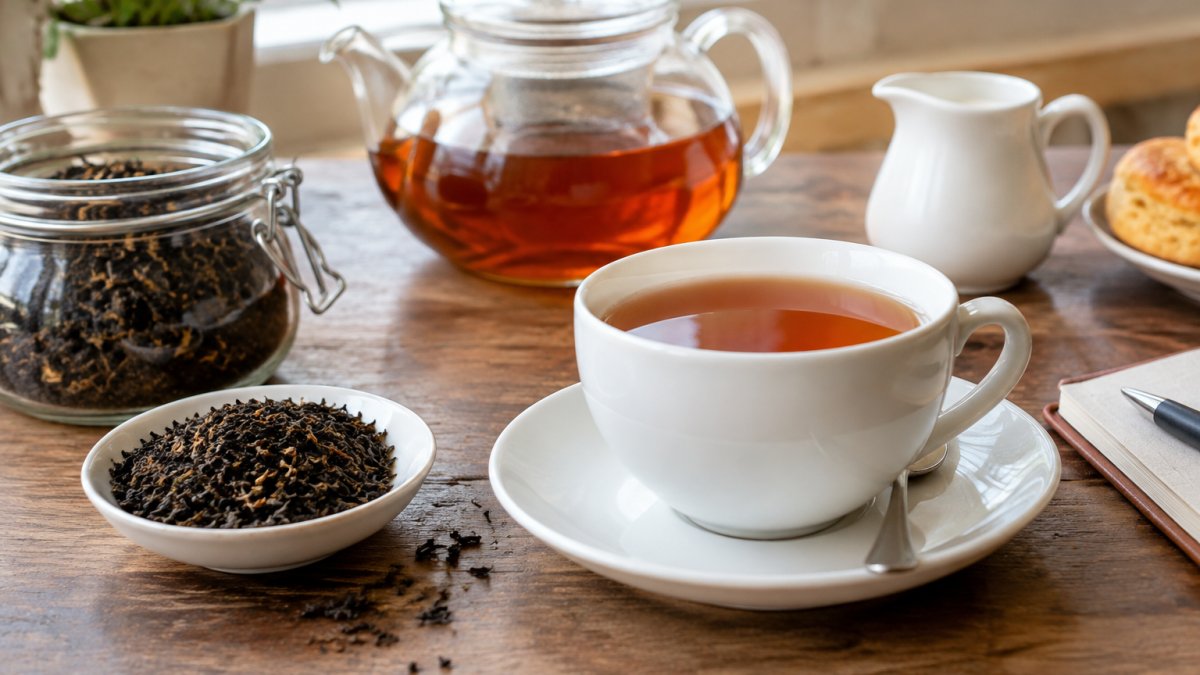
English Breakfast and Irish Breakfast are style names, not protected recipes. No regulator defines either one, so two boxes with the same label can taste completely different. Both are black tea blends built on Assam and Ceylon, and both are designed to take milk. The difference is emphasis, and the emphasis is usually visible in the ingredient order.
English Breakfast tends to balance malty Assam with brisk Ceylon for a rounded, versatile cup. A common pattern is roughly equal parts Assam, Ceylon, and a softer African leaf such as Kenyan or Rwandan tea, which adds body without much astringency. Irish Breakfast usually leans harder on Assam, often two parts Assam to one part Ceylon, which gives it a stronger, thicker body and a more assertive finish. Some Irish-style blends add a small amount of broken-grade leaf to push the color and strength up further.
Neither name tells you the exact blend composition, so read the ingredient list. Ingredients are listed in descending order by weight, so the first tea named is the dominant one. If Assam leads, expect malt and body. If Ceylon leads, expect brightness and a drying finish.
A few practical differences follow from that ratio:
- Milk tolerance: Irish-style blends hold more milk before the tea disappears, because the Assam base is heavier. English-style blends can take a splash but go flat with a generous pour.
- Steep time: Irish-style blends often peak at 4 to 5 minutes, while English-style blends can taste muddy past 4. Start shorter and add time.
- Water temperature: both do best near 195 F to 205 F.
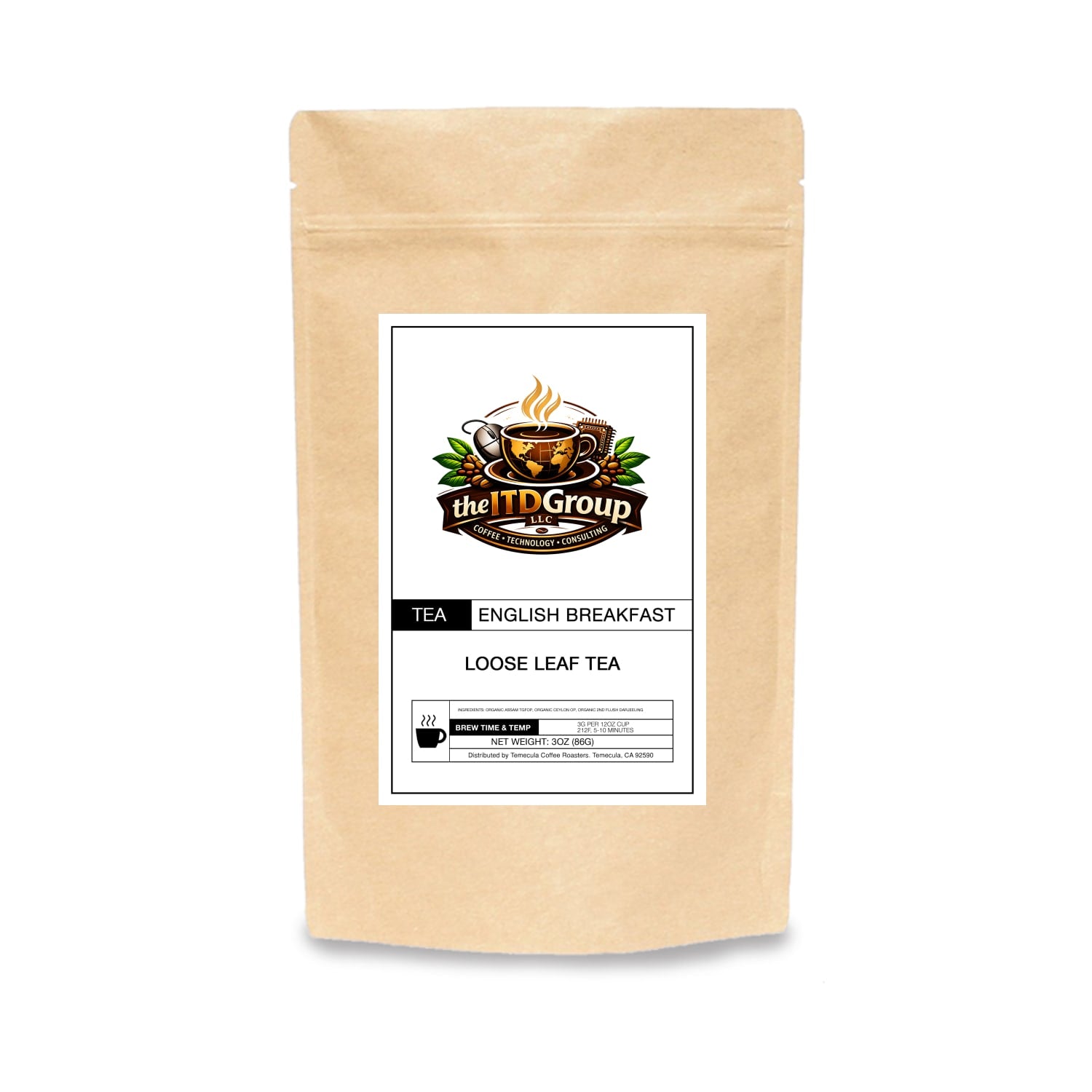
Our English Breakfast is a blend of African and Indian tea, rustic and sweet, built to stand up to milk and sugar. That is the English style in practice: strong enough to hold its own, not so aggressive that it overwhelms. If you want the Irish direction, look for a blend where Assam is the first ingredient and the leaf grade includes some broken pieces.
Watch out: assuming a label that says "Irish" is stronger. Some Irish-style blends are all Ceylon with a dark name, and they brew lighter than a well-made English blend.
Why the Best English Breakfast Tea Loose Leaf Beats Bags
The Earl Grey listing recommends 2.5 grams per 12 ounces of water for a 5 to 10 minute steep at 195 F.
If you are new to loose leaf, learn to spot quality before you buy. How to identify quality loose tea covers leaf appearance, aroma, and freshness markers.
Breakfast Tea Caffeine: How Much Is in Your Cup
Breakfast tea caffeine content depends on the leaf, the dose, and the steep time, not on the name of the blend.
Three things raise the caffeine in your cup: more leaf, hotter water, and a longer steep. If you are sensitive, shorten the steep rather than switching blends. The FDA guidance on caffeine and how much is too much is a useful reference for daily limits.
Strength and caffeine are not the same thing. A dark, full-bodied cup can be lower in caffeine than a lighter one brewed with more leaf.
The Best English Breakfast Tea Recipe for Your Brew Style
For Earl Grey, the listing recommends 2.5 grams of leaf per 12 ounces of water at 195 F, steeped 5 to 10 minutes.
Adjust by method:
For a full walkthrough of ratios, temperatures, and re-steeping, see best ways to brew loose leaf tea.
Compare Blends: A Quick Buying Table
Use this table to match a blend to how you actually drink your tea, then use the criteria below it to compare packs on value rather than label alone.
| Blend | Flavor Profile | Best For | Skip If |
|---|---|---|---|
| English Breakfast | Malty, rustic, sweet | Milk and sugar drinkers | You want a delicate cup |
| Masala Chai | Full-bodied, spicy, aromatic | Milk-based and warming | You dislike spice |
| Earl Grey | Orange, floral, malty | Black tea, no milk | You want zero bergamot |
| Moroccan Mint | Smooth green tea, fresh mint | Hot or iced | You want a black tea |
| Jasmine | Medium-bodied, sweet, silky | Multiple steepings | You want a strong morning cup |
| Matcha | Refined, lingering | Traditional preparation | You want a steeped leaf tea |
All six are $22.99. Our Masala Chai is full-bodied and intense, and it works served with milk and sugar or on its own. Earl Grey's listing recommends brewing at 195 F for 5 to 10 minutes with 2.5 grams per 12 ounces.
Compare Packs on Value, Not Just Price
A $22.99 tin and a $9.99 box are not comparable until you know how many cups each one brews. The number that matters is cost per cup.
Pick Your Blend and Brew It Tomorrow Morning
Choosing a breakfast tea blend comes down to four decisions: flavor direction, milk or no milk, loose leaf or bag, and how much caffeine you want. Answer those and the shortlist writes itself.
Start with English Breakfast if you want the classic malty cup with milk. Move to Masala Chai for spice, Earl Grey for citrus and floral notes, or Moroccan Mint and Jasmine if you prefer green tea. Matcha suits a slower ritual.
Once you have your leaves, protect them. How to store tea leaves properly covers containers, light, and shelf life.
The gap between a good morning cup and a great one is usually the leaf, not the technique. theITDGroup LLC sources teas carefully and roasts coffee to order, so what arrives is fresh and aromatic. Ordering is simple, delivery is reliable, and every batch is packed for flavor. Get started with theITDGroup LLC and brew a cup that actually tastes like the description.
Frequently Asked Questions
What is the difference between English, Irish, and Scottish breakfast tea?
The names signal strength and blend composition more than origin. English breakfast tends to be a balanced blend of Assam, Ceylon, and sometimes African tea, built to take milk and sugar. Irish breakfast leans heavier on Assam for a thicker, maltier cup. Scottish breakfast is usually the boldest, with a brisk, full-bodied edge. None of these styles is tied to a single tea origin, so read the blend composition on the label to know what you are actually buying.
How much caffeine is in breakfast tea?
Caffeine in a cup of black breakfast tea depends on leaf grade, dose, and steeping time. Longer steeps and more leaf push the number up. If you are watching intake, measure your leaves rather than eyeballing them and keep the steep to three to five minutes.
Should breakfast tea be served with milk?
It depends on the blend. A malty Assam-forward breakfast tea holds up well to milk and sugar because the body and astringency balance the dairy. A lighter Ceylon-dominant blend can taste thin once milk goes in. Try the first cup plain to read the flavor profile, then add milk on the second steep.
How do you choose a high-quality loose leaf breakfast tea?
Look for whole or large broken leaves rather than dust, a clear blend composition naming the origins, and a harvest or roast date on the packaging. Buy in amounts you can use while the leaves are fresh, and brew at the temperature the label recommends.