 how-to
How to Bloom Coffee Grounds Properly for a Better Cup
Last Updated: November 12, 2026
Quick Summary
To bloom coffee, pour about twice the weight of your grounds in water at roughly 200°F, then wait 30 to 40 seconds before the main brew. A 20-gram dose gets about 40 grams of bloom water. This lets trapped carbon dioxide escape so water saturates the bed evenly.
- Fresh grounds hold carbon dioxide from roasting, and the bloom lets that gas escape first.
- Rinse the filter, level 20 grams of medium-ground coffee, then pour 40 grams of water in slow circles.
- Drip brewers with a pre-infusion setting pause 20 to 45 seconds, though some pause only 15 seconds.
- A 60-gram batch dose needs about 120 grams of bloom water and a 40-to-45-second wait.
- Skipping the bloom can leave sour and bitter notes in the same sip from uneven extraction.
Table of Contents
- What Blooming Coffee Grounds Actually Does
- How to Bloom Coffee Pour Over: A Repeatable Recipe
- How Long to Bloom Coffee and How Much Water to Use
- How to Bloom Coffee in a Drip Coffee Maker
- What Happens If You Don't Bloom Coffee
- Adjusting the Bloom for Roast, Freshness, and Grind
- Troubleshooting Uneven or Weak Blooms
- Find Your Perfect Roast for Blooming
- Frequently Asked Questions
What Blooming Coffee Grounds Actually Does
Blooming coffee grounds is the step of pouring a small amount of hot water over fresh grounds and waiting before the main brew.
Here is the short version. Fresh grounds hold carbon dioxide from roasting. That gas pushes back against water.
- Carbon dioxide release: gas leaves the grounds as bubbles and foam
- Even saturation: water wets the whole coffee bed
- Better extraction: flavor compounds dissolve more evenly
Skipping it can leave the gas fighting your water, which may produce a flatter, less even cup.
How to Bloom Coffee Pour Over: A Repeatable Recipe
A common pour-over bloom uses about twice the weight of your coffee in water, poured gently, then a short wait.
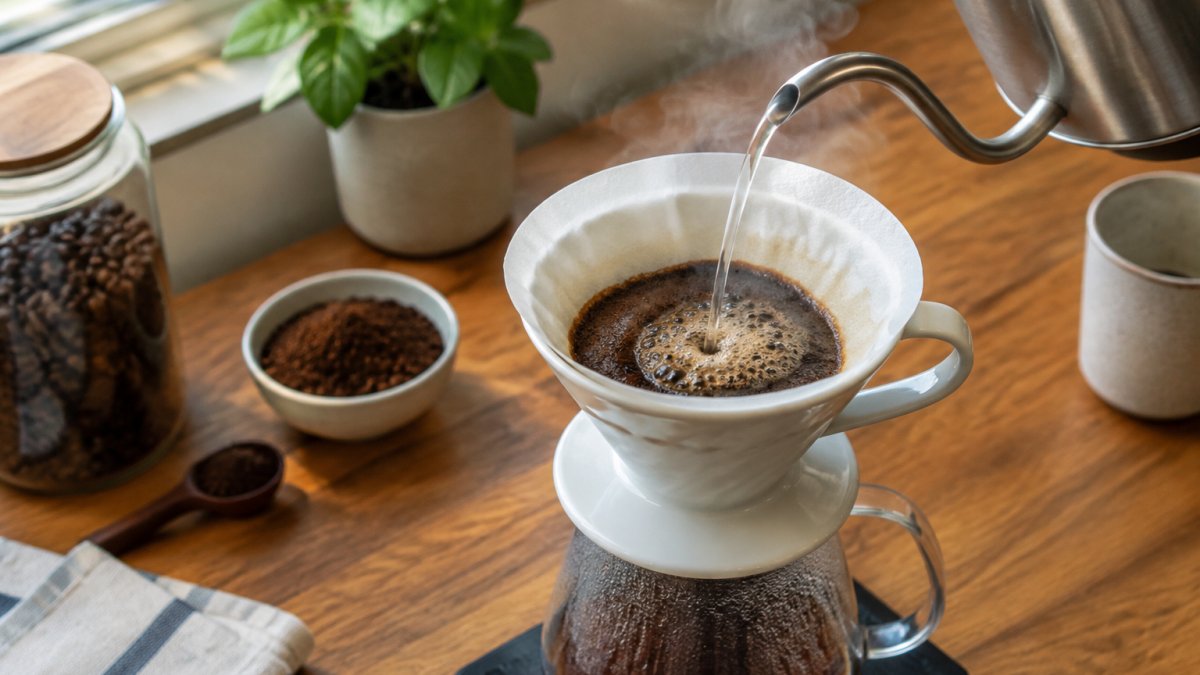
Start with these ratios:
- Coffee dose: 20 grams
- Bloom water: 40 grams, about twice the dose
- Water temp: just off a boil, around 200°F
Step-by-Step Pour-Over Bloom
- Rinse the filter with hot water, then discard that water.
- Add 20 grams of medium-ground coffee and level the bed.
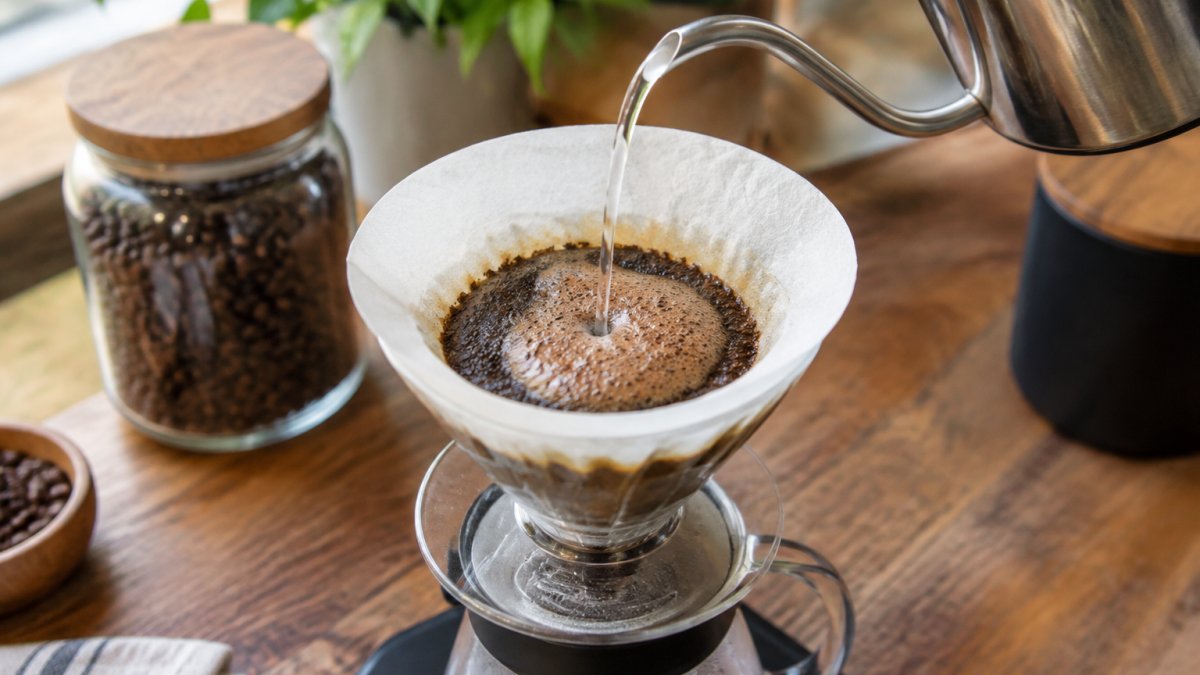
- Start a timer and pour 40 grams of water in slow circles.
- Make sure every dry patch gets wet.
- Wait 30 to 40 seconds while the bed puffs and bubbles.
- Continue pouring the remaining brew water in stages.
- Let it drain fully, then taste and adjust.
For the full walkthrough around this step, see our guide on how to brew pour-over coffee at home.
How Long to Bloom Coffee and How Much Water to Use
Bloom for 30 to 40 seconds and use about twice your coffee's weight in water. A 20-gram dose gets roughly 40 grams of bloom water. That window is long enough for most of the gas to escape without cooling the bed.
Watch your bloom for clues:
- Big puff and lots of foam: very fresh coffee, good sign
- Small, quick bubble: older or darker roast
- Dry patches on top: your pour was too fast or too centered
How to Bloom Coffee in a Drip Coffee Maker
A drip machine can bloom coffee, but only if you understand how it delivers water. Most automatic brewers send the first water through a shower head in a few seconds and never pause, so the grounds get wet and immediately start draining.
There are three practical ways to get a real bloom out of a drip brewer, depending on what your machine offers.
1. Use the built-in pre-infusion or bloom setting
Many mid-range and higher-end drip brewers include a pre-infusion cycle, sometimes labeled "bloom," "pre-wet," or "pre-infusion." The machine releases a small volume of water, pauses 20 to 45 seconds, then resumes the full brew. If yours has this, turn it on and leave it on, it is the closest thing to a hands-off proper bloom. Check your manual for the pause length; some machines pause only 15 seconds, which is shorter than the 30 to 40 seconds a fresh light roast wants.
2. Manual bloom before starting the cycle
If your machine has no pre-infusion setting, bloom by hand before you press start:
- Add your grounds to the filter and level the bed.
- Heat water separately to about 200°F.
- Pour roughly twice the coffee's weight in water over the bed, for a 60-gram batch dose, that is about 120 grams of bloom water.
- Wait 30 to 40 seconds while the bed puffs.
- Start the brew cycle as normal. The machine's water will finish the job.
Watch out: if you pour the bloom water and then walk away for two minutes, the bed cools and the first part of the brew starts from a lower temperature. Keep the pause to the 30-to-40-second window.
3. Batch brewers and larger doses
The same logic scales, but the numbers change. A 60-gram dose in a batch brewer needs about 120 grams of bloom water and a slightly longer wait, 40 to 45 seconds, because the deeper bed traps gas longer. A 100-gram batch dose can take 50 seconds before the hard bubbling stops. Do not simply double the pour-over timing; scale the water to the dose (roughly 2x by weight) and add 5 to 10 seconds for every additional 20 grams of coffee.
What about machines with no pause at all?
A basic drip machine with a fixed cycle and no pre-infusion gives you two options. The manual bloom above works if you are willing to pour before starting. If you are not, accept that the machine's first few seconds of water are your only bloom, and compensate by grinding slightly coarser so the bed drains more evenly.
If you are deciding between a dripper and a machine, our comparison of pour over vs drip coffee taste covers how the two methods differ in the cup.
What Happens If You Don't Bloom Coffee
Skipping the bloom usually gives you a less even cup. The trapped gas blocks water from some grounds while over-soaking others. You get sour notes and bitter notes in the same sip.
The signs of a skipped bloom:
- Sour, sharp finish from under-extraction
- Weak body because water channeled through gaps
- Uneven flavor that changes from sip to sip
- Fast drain as water slips past dry clumps
It is not ruined coffee. It is just coffee that could taste better. The fix takes 30 seconds.
Adjusting the Bloom for Roast, Freshness, and Grind
Your bloom should change with the bean. Fresh, light roasts hold more gas and need a longer, gentler bloom. Darker or older beans release gas fast and need less.
Use this as a starting point:
| Bean Type | Bloom Water | Wait Time | Notes |
|---|---|---|---|
| Light, very fresh | 2.5x dose | 45 seconds | Expect a big puff |
| Medium, fresh | 2x dose | 30-40 seconds | Standard recipe |
| Dark roast | 2x dose | 25-30 seconds | Less foam, watch heat |
| Older beans | 2x dose | 20-25 seconds | Small bubble, move on |
Wait Time
Grind size matters too. A finer grind blooms slower because water drains through it more slowly. For grind guidance, read what's the best grind size for pour over coffee.
Roast level also shifts your approach. Our guide to brewing light roast coffee covers the full method. And because freshness drives the bloom, it helps to know why fresh roasted coffee tastes better.
Troubleshooting Uneven or Weak Blooms
Most bloom problems trace back to one of three things: how you pour, how the grounds are ground, or how fresh the beans are. Work through them in that order, because pouring is the easiest to fix and the most common culprit.
Symptom: dry patches on top of the bed
Likely cause: the pour was too fast, too centered, or both. Water hit the middle and ran down before it reached the edges.
Fix: slow the stream and move in wider circles, starting at the center and working outward to just inside the filter wall. A gooseneck kettle helps here because it gives you a thin, controllable stream.
Symptom: water drains straight through the bed
Likely cause: the grind is too coarse for the dose, or you poured too aggressively and opened a channel. Water always takes the path of least resistance, and a coarse bed gives it an easy one.
Fix: grind finer in small steps, one notch at a time on a stepped grinder, and pour more gently. If the bed still drains in under 15 seconds during the bloom, the grind is almost certainly too coarse for pour-over.
Symptom: no puff and little or no bubbling
Likely cause: the beans are older or were stored poorly. Coffee loses carbon dioxide over time, and a bean roasted weeks ago simply has less gas to release.
Fix: bloom shorter, 20 to 25 seconds is enough, and move on to the main pour. Do not add more bloom water hoping for a reaction; you will only cool the bed.
Symptom: foam spills over the dripper
Likely cause: too much bloom water for the dose, a dripper that is too small for the batch, or an extremely fresh light roast releasing gas fast.
Fix: reduce the bloom water to about 1.5x the dose for very fresh beans, or use a larger dripper. A 20-gram dose in a small cone can overflow if you pour 50 grams of water at once; pour in two short stages instead.
Symptom: the bed caves in the middle
Likely cause: an aggressive center pour drilled a hole through the grounds. Water then runs down that channel and leaves the rest of the bed dry, the classic channeling failure.
Fix: keep the stream moving and never hold it in one spot. If the bed already caved, stir gently with a spoon to level it before continuing, but expect a slightly uneven extraction.
Symptom: the bloom looks fine but the cup tastes weak or sour
Likely cause: the bloom was fine but the main pour under-extracted, often because the total brew time was too short or the grind was too coarse.
Fix: check your total brew time against your dose and grind. If the whole brew finishes in under two minutes for a 20-gram pour-over, grind finer or slow the pour.
A loose or wrong-sized filter is a separate, easy-to-miss cause of uneven flow.
Find Your Perfect Roast for Blooming
Fresh beans bloom best, which is why freshness matters. A lively bloom tells you the coffee still has gas and flavor to give. Flat, quiet grounds tell you the beans have been sitting.
Our single-origin lineup gives you room to test the bloom across roast levels and regions:
- Ethiopia Natural ($23.99): medium-light, with milk chocolate, fruity, and caramel notes
- Colombia ($23.99): medium roast, with dried orange, berry, and chocolate
- Guatemala ($23.99): medium roast, with dark chocolate, bright fruit, and butterscotch
- Brazil Santos ($23.99): medium roast, with an elegant, smooth cup and cocoa notes
Try two roasts side by side and watch how the bloom differs.
Blooming is a small step that changes the whole cup, and fresh coffee makes it work.
Frequently Asked Questions
How long should you let coffee grounds bloom?
Most pour-over recipes call for a bloom of 30 to 45 seconds. During this window the coffee bed puffs up, bubbles, and releases trapped carbon dioxide. If your beans are very fresh, roasted within the past week, give the bloom the full 45 seconds. Older beans degas less and may only need 30 seconds before the bed settles and you can continue pouring your remaining brew water.
How much water should you use to bloom coffee?
Use roughly twice the weight of your coffee grounds in water. For a 20-gram dose, that means about 40 grams (roughly 40 milliliters) of hot water. This bloom ratio wets the entire coffee bed without starting full extraction too early. Pour in a slow circular motion to saturate every dry pocket, then wait for the bed to puff before continuing with the rest of your brew water.
Can you bloom coffee in a drip coffee maker?
Yes, you can bloom coffee in a drip coffee maker with a manual pause. Add your grounds, start the brew cycle, and let the first small burst of hot water hit the bed. Pause the machine, or simply let the initial water sit for 30 seconds before the cycle continues, so the grounds can degas. If your machine has no pause function, a quick pre-wet with a kettle before starting the brew achieves the same effect.
What happens if you don't bloom coffee?
Skipping the bloom lets carbon dioxide escape during the main pour, where it blocks water from reaching the grounds evenly. The result is uneven saturation, under-extraction, and a cup that tastes sour, thin, or hollow. Blooming coffee first releases that gas so the water can extract sweetness and clarity. You will not ruin the cup by skipping it, but a 30-second bloom reliably improves balance and flavor.